Beth O'Dwyer: Bridging Remote Sensing and AI for Urban Climate Adaptation
Beth O'Dwyer is a PhD researcher at the Bern University of Applied Sciences (BFH) and one of the younger #WomenInUrbanAIR project. Today, she talks about how she applies her expertise in AI and Remote Sensing to support real-world cities' resilience, why inclusivity is key to high-tech projects like UrbanAIR and what young women interested in a science career should keep in mind.

What inspired you to pursue a career in atmospheric science? What inspired you to join the UrbanAIR project?
I was inspired to join the UrbanAIR project for a few reasons. The type of work itself is very interesting to me: using machine learning and satellite data to solve a problem. I also liked that there was room to carry out the research in my own way, to follow approaches that appeal to me. The real-world impact of the project was a massive motivator too, and the opportunity to be part of a large, multi-disciplinary team.
Could you describe your specific role and contribution to the UrbanAIR digital twin project? For example, how does your work with satellite data and AI help cities like Antwerp, Barcelona, or Paris become more resilient?
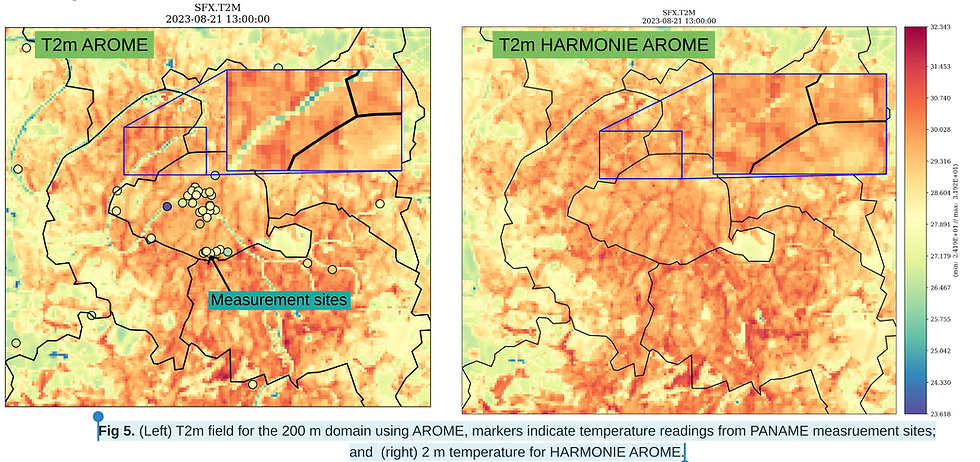
I work on the UrbanAIR project as a PhD student, and my research involves developing an emulator model to provide real-time estimates of land surface temperature. I do this using satellite data that measures infrared radiation coming from the ground, along with an AI model. I aim to estimate how these measurements will be impacted by climate change over the next 100 years. Land surface temperature is a useful metric of the Surface Urban Heat Island effect (SUHI), which is the temperature difference between cities and their surrounding rural areas. Investigating how climate change will potentially accelerate this effect is useful for cities to plan accordingly.
The UrbanAIR project relies on a very diverse team of experts. How does the inclusion of diverse perspectives - within the team, in the decisions, data and behaviours we model, and in the citizens and stakeholders that we involve in our project - improve the quality and equity of the project’s outcomes?
The inclusion of diverse perspectives is extremely important in developing such a multi-faceted tool and a project that combines the work of a multi-disciplinary team. It’s helpful to combine different perspectives to cater to a wide range of audiences. Women in particular are excellent at being attuned to quieter voices in the room and helping people feel heard. This discernment is very useful for tackling challenges like this that need creative approaches.
As part of UrbanAIR, what advice would you give to young women considering a career in science, like climate research or urban planning?
For young women considering a career in climate research or urban planning, my advice would be to make the most of every opportunity that comes your way in terms of research, leadership, and teamwork. Being a well-rounded researcher is invaluable, and it’s also a way to make connections and learn about fields that you may not have been exposed to so far.
It’s also important not to put pressure on yourself to know everything about your area of interest; learning and asking questions along the way is what it’s about.



Comments