Scaling New Heights: UrbanAIR at the ACCORD ASW in Marrakesh
Updated: Apr 21
This article features the work of early-career researcher Abhilash Menon at the SMHI, contributing to the European UrbanAIR project.
The 6th ACCORD All Staff Workshop (ASW) in Marrakesh (13-17 April, 2026), provided a vibrant stage for the latest updates from UrbanAIR, our pioneering Horizon Europe project dedicated to bridging the gap between large-scale climate models and the hyper-local realities of city life.
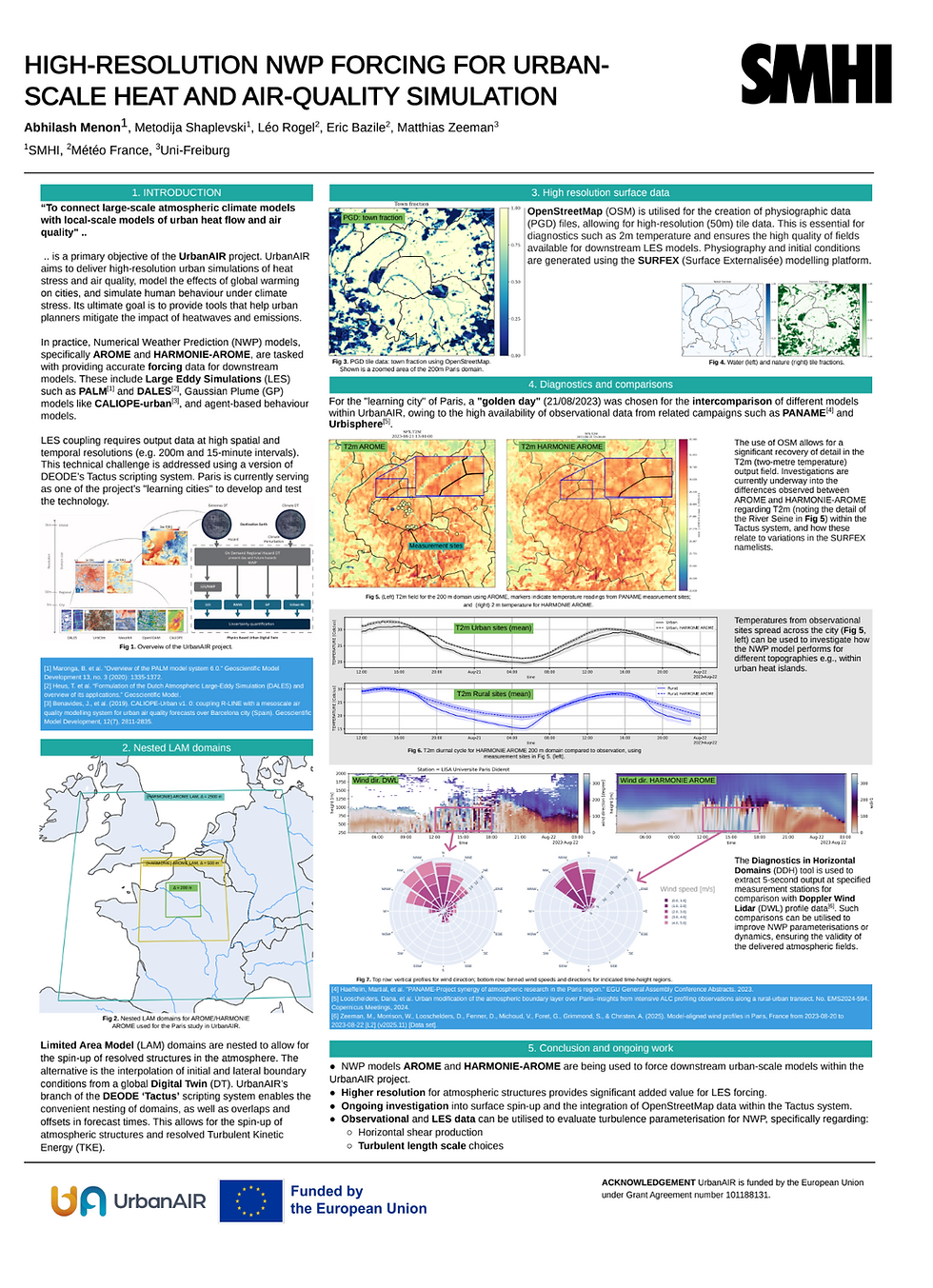
Bringing together experts from SMHI, Météo-France, KNMI, and the University of Freiburg, the project showcased how high-resolution Numerical Weather Prediction (NWP) is being transformed into a "Physics-Based Urban Digital Twin." Abhilash Menon represented the project team with a poster presentation during the event, titled “High-Resolution NWP Forcing For Urban-Scale Heat and Air-Quality Simulation”.
The Vision: A Physics-Based Urban Digital Twin for Urban Resilience

UrbanAIR’s primary objective is to deliver high-fidelity simulations of urban heat stress and air quality. By modelling how global warming impacts cities and simulating human behaviour under climate stress, the project provides essential tools for urban planners to mitigate the risks of heatwaves and emissions.
At the heart of this initiative are the AROME and HARMONIE-AROME models. These serve as the "forcing" engines, providing the essential atmospheric data to drive downstream models such as Large Eddy Simulations (LES) (e.g., PALM, DALES) and Gaussian Plume (GP) models like CALIOPE-urban.
Technical Innovation: Nested Domains and "Tactus"
To capture the complex turbulence of a city, the team employs Nested Limited Area Model (LAM) domains. This allows for the "spin-up" of resolved atmospheric structures and Turbulent Kinetic Energy (TKE)—the invisible swirls of air that dictate how heat and pollution move through streets.
A technical highlight shared in Marrakesh was the use of the DEODE ‘Tactus’ scripting system. This customized branch of Tactus enables:
Seamless nesting of domains (scaling from 2500m down to 200m).
Flexible timing offsets, ensuring the atmospheric physics are fully stabilized before data is passed to city-scale models.

Precision Mapping with OpenStreetMap
Accurate urban modelling requires knowing exactly what is on the ground. The team is utilizing OpenStreetMap (OSM) to create high-resolution physiographic data (PGD) files. Integrated into the SURFEX modelling platform, this provides 50m resolution tile data.
This granularity allows the models to distinguish between dense city centres, parks, and water bodies, leading to a significant "recovery of detail" in temperature fields.
Fig.3 Town fraction Fig.4a. Water fraction Fig.4b. Nature fraction
Learning from the "Golden Day" in Paris
Paris serves as one of UrbanAIR’s "learning cities." The team presented results from a "Golden Day" (August 21, 2023), a period with high data availability from campaigns like PANAME and Urbisphere.
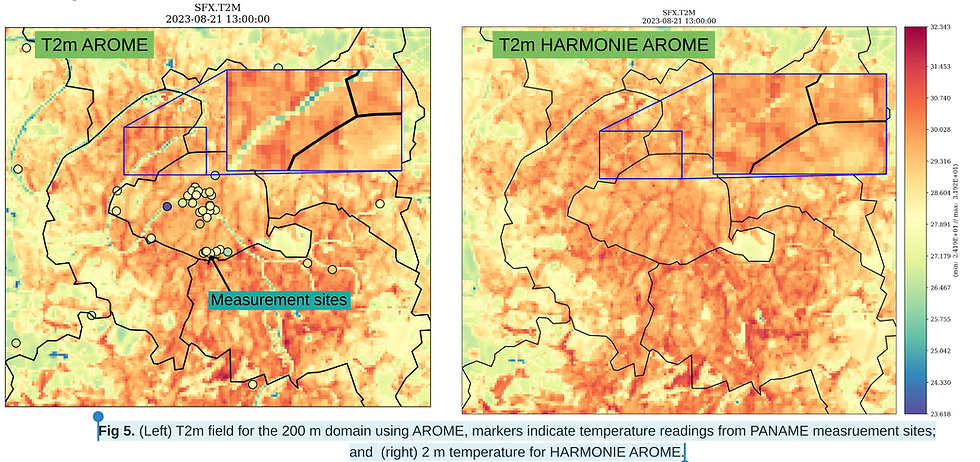
By comparing AROME and HARMONIE-AROME, researchers are investigating how different surface parameters impact local forecasts—even capturing the cooling footprint of the River Seine.
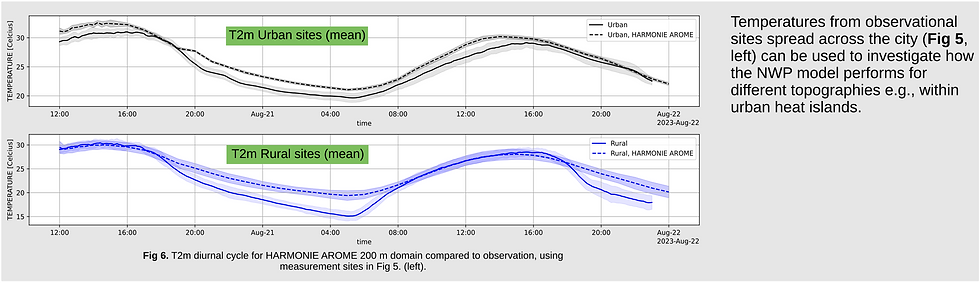
Validation against observational sites across Paris helps ensure the models accurately represent Urban Heat Islands, where city temperatures can remain dangerously high compared to rural surroundings.
The Path Forward
The UrbanAIR poster presentation concluded with a roadmap for the project's next phases:
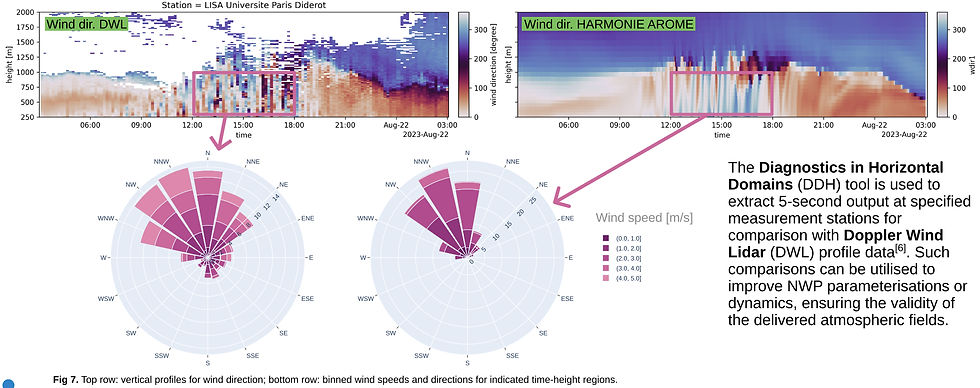
Evaluating turbulence parameterization using Doppler Wind Lidar data.
Refining horizontal shear production within urban canopy models.
Scaling the Digital Twin for broader use in municipal decision-making.
As UrbanAIR continues to develop, it remains a key component of the Destination Earth framework, empowering cities to build a healthier, more resilient future.
The poster presented by Abhilash Menon is available to preview and download below.
More members of the UrbanAIR team from the KNMI also represented the project in the event:
Natalie Theeuwes, leading researcher in KNMI and the UrbanAIR project participated in the session about Meteorological Quality Assurance, on April 14th, with a presentation about Developments and Process‑Based Evaluation of Hectometric‑Scale NWP
Hilke Lentink presented a poster titled Pseudo Global Warming approach in HCLIM and Tactus


About the ACCORD Consortium and the ASW
The ACCORD All Staff Workshop is more than just a conference; it is the primary hub for scientific exchange within the ACCORD consortium (A Consortium for Convection-scale modelling Research and Development).
Bringing together 26 National Meteorological Services across Europe and North Africa, ACCORD is the largest research partnership of its kind. Participating in the ASW allows UrbanAIR to align its "Urban Digital Twin" with the broader strategic goals of European weather science, ensuring our tools meet the highest operational standards for a more resilient future.
Contributors: Abhilash Menon, Metodija Shaplevski & Ulf andrae (SMHI), Léo Rogel & Eric Bazile (Météo-France), Matthias Zeeman (Uni-Freiburg).
This feature is part of our #UAYoungResearchers campaign. We are shining a spotlight on the PhD students, postdocs, and early-career scientists like Abhilash who are a key driving force behind the UrbanAIR project.
Follow the journey: Check out the #UAYoungResearchers hashtag on social media to see "behind-the-scenes" lab work, field campaigns from our pilot cities, and more interviews with the next generation of climate and air quality experts.
For more updates subscribe to our newsletter here.
Acknowledgement: UrbanAIR is funded by the European Union under Grant Agreement number 101188131.


Comments