#WomenInUrbanAir: Cristina Carnerero on air pollution and urban resilience

To celebrate International Women’s Day 2026, our #WomenInUrbanAIR campaign spotlights the researchers ensuring that urban resilience leaves no one behind. We are proud to feature Cristina Carnerero, an atmospheric scientist at the Barcelona Supercomputing Center, contributing to the UrbanAIR Digital Twin.
Since launching this campaign in February, we have explored many facets of STEM, but Cristina’s work on air pollution is a vital reminder of why diversity in research matters: environmental risks affect people differently based on gender, age, and mobility. In this interview, Cristina discusses her journey in atmospheric science, the power of inclusive data, and why "everyday" female role models are the true backbone of scientific progress.
What inspired you to pursue a career in atmospheric science? What inspired you to join the UrbanAIR project?
My motivation to pursue a career in atmospheric science is the profound impact atmospheric events have on society and people’s lives and health. Although these events cannot always be prevented, their impacts can be reduced. By better understanding the atmosphere, we can provide earlier and more accurate warnings, allowing communities and decision-makers to prepare and respond effectively. Knowing that our work can help protect lives and give people the opportunity to avoid danger or reduce harm is what drove my interest in this field.

Could you describe your specific role and contribution to the UrbanAIR digital twin project? For example, how does your work with air pollution data help cities like Antwerp, Barcelona or Paris become more resilient?
Through my contribution to UrbanAIR, I aim to support Barcelona in becoming more resilient to air pollution by improving how air quality data is used in decision-making. The UrbanAIR tool will bring different layers of information together in a clear and intuitive way, allowing users to explore and understand complex relationships by leveraging modelling tools without requiring technical expertise.
The tool will help identify areas of the city that do not meet regulated pollution standards, as well as populations that are more vulnerable due to factors such as place of residence, age, gender, income level, or mobility patterns. This will enable decision makers to make informed decisions that better protect public health.
The UrbanAIR project relies on a very diverse team of experts. How does the inclusion of diverse perspectives - within the team, in the decisions, data and behaviours we model, and in the citizens and stakeholders that we involve in our project - improve the quality and equity of the project’s outcomes?
Air pollution and heat do not affect all people in the same way. Differences in gender, age, health, socioeconomic status, and daily mobility shape how citizens experience environmental exposure across the city. By including diverse perspectives, we will have a more complete understanding of exposure and will allow us to represent the reality of the city more accurately. This will also enable users to make better-informed decisions that account for the needs and vulnerabilities of the entire population.
Cristina Carnerero and Jan Mateau are presenting the progress of the Digital Twin User Journey work for Barcelona to the UrbanAIR consortium
Looking ahead, what is one key misconception about women in STEM that you wish to challenge? And, as part of UrbanAIR, what advice would you give to young women considering a career in climate research or urban planning?
A common misconception about women in STEM is that young women lack female role models. Women have always contributed to science, even if their work has often been undervalued or pushed out of the spotlight.
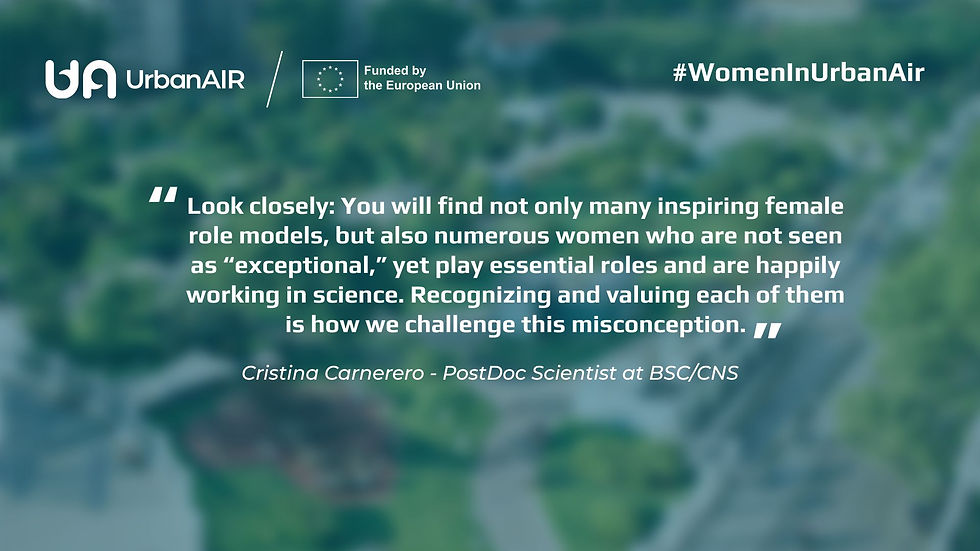
My advice to young women considering a career in STEM is to look closely: they will find not only many inspiring female role models, but also numerous women who are not seen as “exceptional,” yet play essential roles and are happily working in science. Recognising and valuing each of them is how we challenge this misconception.
Stay tuned to our news webpage and follow our campaign #WomenInUrbanAIR to learn more about gender equality in the UrbanAIR project.


Comments