#WomenInUrbanAIR: Femke Vossepoel is leading a tech project focusing on the human aspect
Updated: Feb 13

Women lead only 31% of Horizon Europe consortia. Femke Vossepoel, Professor of Earth System Simulation at TUDelft, is part of this leading group as the Scientific Coordinator of UrbanAIR. For Femke, leading a high-tech project isn't just about the algorithms; it’s about the people they serve. In this interview, we explore her journey through computational geosciences and data assimilation, her role in building urban digital twins for climate resilience, and why she believes inclusivity and co-design are the true 'human' engines of scientific innovation.
What inspired you to pursue a career in Earth System Simulation and uncertainty quantification? What inspired you to join the UrbanAIR project?
As a student, I was fascinated by satellite observations of the Earth – incredible how accurately we can observe the Earth with all human and natural processes from space, and how beautiful these processes can be! Over the years, I have developed methods to combine these and other observations with dynamical models of Earth processes and quantify uncertainties with techniques commonly referred to as data assimilation. UrbanAIR now gives me the opportunity to use these techniques for urgent and important problems that affect society. For me, that was the reason to initiate and coordinate the UrbanAIR project.
Could you describe your specific role and contribution to the UrbanAIR digital twin project? For example, how does your work with Uncertainty Quantification help cities become more resilient?
As the scientific coordinator of UrbanAIR, my role is to ensure that all experts have a unified view on the digital twin (or twins) we will deliver, and that all modules they build are connected. I also try to make sure that people know each other and know where to go for help or collaboration. This also makes the project much more fun!
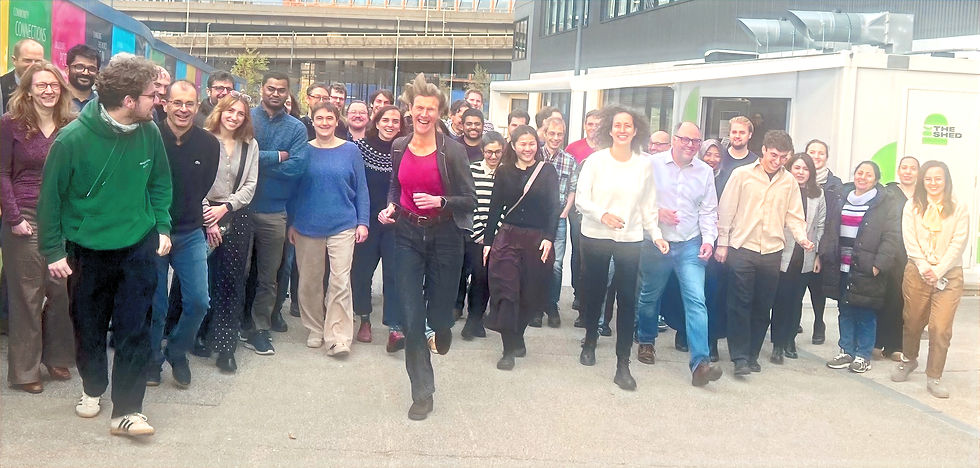
In addition to being the scientific coordinator, I am the theme lead for Theme 4 on Uncertainty Quantification. As a theme, we are combining numerical models for the atmospheric flow with measurements of temperature, wind velocity, and air quality. By doing so, we can test the validity of the model calculations and say something about the uncertainties in our simulations and forecasts.
Theme 4 also comprises machine-learning specialists, who use techniques to optimise how we make use of the available (satellite) observations, and they build so-called surrogate models of the atmospheric models, which allows us to compute the atmospheric conditions for many different scenarios. It is also very important to know the uncertainties, which should eventually help decision makers to know the associated risks of their decisions.
The UrbanAIR project relies on a very diverse team of experts. How does the inclusion of diverse perspectives within the team, and in the decisions, the data and behaviours modelled, and the citizens and stakeholders involved in the project, improve the quality and equity of the project’s outcomes?
Within UrbanAIR, we all have different cultural backgrounds, nationalities, and genders. Most of us have a similar education, and not all of us live in a city. It is therefore extremely important that we engage with a broad range of stakeholders and involve ALL types of citizens and stakeholders in the design and application of our tools. It is very easy (and sometimes quick and seemingly efficient) to only talk to and think about one group of users when developing a digital twin or a part thereof, but if we don’t consider a wide and diverse audience, our efforts will have only a limited impact.

Already when together as a consortium, we see the value of diversity at play: Sharing ideas with a broad range of colleagues forces me to explain concepts well known to me, and my direct colleagues in uncertainty quantification, to colleagues working in stakeholder engagement or communication, for example. By listening to the responses of experts in other fields than our own, we are invited to take a fresh look at our own work, which in turn inspires us to take new and often innovative approaches.
Ultimately, by including the viewpoints of those different from us, we can make sure that the tool that we build makes sense not only to ourselves but also to other members of society. Since our digital twin is meant to serve society, it is extremely important for us to continuously try to create diverse teams and engage with a variety of people with different perspectives.
Looking ahead, what is one key misconception about women in STEM that you wish to challenge?
I think misconceptions about women in STEM can be very subtle. Today, teachers, colleagues, family and friends will not question a girl’s or woman’s ability to understand math or physics, as perhaps they used to do when I was much younger.
However, I do think there is a general misconception in STEM that no matter your gender, to succeed, you have to be tough and not show your emotions. I think the ability to show your emotions and be honest about your doubts and fears can be a real asset, especially in the world of STEM, where there is a general tendency to rationalise everything. Especially in the field that I work in, where we aim to quantify uncertainties for decision making, it is important to consider all types of risks and uncertainties, even if they cannot be quantified, because making in the decision may not be as rational as we sometimes assume it is.
And, as part of UrbanAIR, what advice would you give to young women considering a career in climate research or urban planning?
For young women considering a career in climate research or urban planning, my advice would be to
...trust your own intuition, even if it means stepping into unknown territory and failing: only by making mistakes do we learn and grow.


Comments