Co-designing digital twins for heat and air quality: Lessons from EURESFO 2026
Digital tools are becoming an increasingly important part of how cities understand, plan for and respond to climate risks. Urban digital twins, climate services, geospatial analytics and AI-supported modelling can help cities test scenarios, visualize complex data and make better-informed decisions on issues such as extreme heat, air pollution, flooding and wider climate resilience.
Yet one message is becoming increasingly clear: digital tools only become useful when they are designed around real city needs. Otherwise, we risk contributing to a tool graveyard.
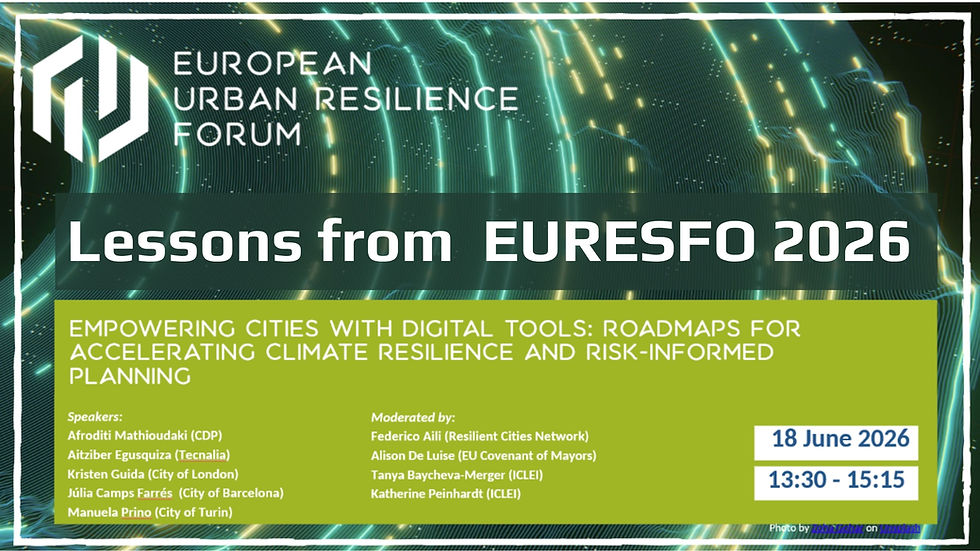
This was the starting point for the workshop “Empowering cities with digital tools: roadmaps for accelerating climate resilience and risk-informed planning”, organised by UrbanAIR together with the EU Covenant of Mayors and ICLEI Europe at the European Urban Resilience Forum 2026 in Guimarães, Portugal. Bringing together 400 urban practitioners and city leaders, the forum provided an ideal setting for UrbanAIR to engage with city representatives and other user groups. The session welcomed around 30 participants, including representatives from Barcelona, Rotterdam, London and Turin, as well as technical partners and city networks.
UrbanAIR aims to support European cities in planning for air quality and heat resilience by developing digital twin applications that provide real-time, street-level forecasts, behavioural insights and user-friendly workflows for climate-smart decisions. The project is currently working with Antwerp and Barcelona as action cities, while also engaging learning cities and a wider community of users.
From technology to city value
The workshop focused less on the technology itself and more on the question cities often face: how can digital tools become part of real planning and decision-making processes?
Participants explored how cities can move from pilot projects to long-term adoption, what barriers limit sustained use, and how tools can remain operational after initial project funding ends. These questions are central for UrbanAIR, because digital twins require much more than good data, sensors, models and dashboards. They also require usability, trust, institutional fit and clear value for the people expected to use them.
The session began with city journeys and examples from Barcelona, Turin, London, CDP and Tecnalia. These inputs showed different ways in which cities and partners are already using, testing or developing digital tools, from air quality modelling and positive energy districts to climate-risk decision support and public-purpose platforms for local governments.
City representatives reflected on the experiences within the local administrations, highlighting needs and requirements, challenges and current developments. Technical partners enriched the discussion by presenting specific applications: the CDB Adaptation and Action Explorer to help public governments understand physical climate and nature risks and identify effective adaptation pathways; and the set of RescueME decision-support tools to select the most effective climate resilience solutions in the context of cultural landscapes.
Key takeaways
Digital tools need a clear problem to solve. Cities should not start with the tool. They should start with the decision they need to improve. For heat and air quality, this may include identifying hotspots, prioritising vulnerable groups, testing greening or shading scenarios, improving emergency response, or supporting local heat action plans. Starting with the planning challenge (not the technology) allows to identify concrete challenges, align with broader city’s policy goals and create an intelligent demand of data.
Promote multi-sectoral and stage-specific tools. Tools and models available to local administrations should be as much as possible multisectoral. At the same time, different planning phases, from visioning and scenario development to implementation and monitoring, require different types of models and analytical capabilities. Some models may be good for planning interventions, while others are good more monitoring existing conditions.
Governance matters as much as technology. Long-term use depends on internal ownership, clear responsibilities, collaboration across departments, data governance and resources for maintenance. Without these, even promising tools risk remaining as isolated pilots. For a city, a roadmap can clarify the steps needed to move from interest to adoption. For technical partners, it helps define realistic development pathways, identify data gaps and understand the operational context in which tools will be used.
End-users must be at the centre of the development process. A useful digital twin is developed through continuous interaction between cities, researchers, technical partners and users. Municipal teams may not need to understand every technical detail of a model, but they do need to understand what a tool can and cannot do, what data it requires, what uncertainty it carries, and how its outputs can inform decisions.
What is next for UrbanAIR and users
For UrbanAIR, the EURESFO session confirmed the importance of building a sustained community of users around digital twin services for heat and air quality. User Committee Meetings are designed to connect city representatives, partners and experts, align the development of digital services with real needs, define good practices for co-production, and create space for peer-to-peer learning. Cities are interested in digital twins and advanced climate services, but they want tools that are practical, understandable and connected to their day-to-day responsibilities. At the same time, technical partners benefit greatly from direct exchanges with municipalities, because these conversations reveal the real conditions under which tools need to operate.
UrbanAIR will continue creating spaces where cities and technical partners can work together, test ideas, discuss barriers and shape digital services that are not only technically robust, but also useful, trusted and adoptable. We invite cities, local authorities, researchers, technology providers and resilience practitioners to join future UrbanAIR sessions. These exchanges are valuable not only for improving digital tools, but also for helping cities better prepare for heat, air pollution and other climate risks.
The future of urban digital twins will not be built by technology alone. It will be built through collaboration, shared learning and a clear focus on the decisions cities need to make.


Comments