The UrbanAIR data assimilation experts at the International EnKF workshop 2026
Updated: Jun 25

Data assimilation (DA)—the science of combining sparse observational data with advanced numerical models to produce more accurate estimates—is at the very core of what we do at UrbanAIR. By integrating physical models with real-time data, our project builds high-fidelity digital twins for urban air quality and heat mitigation as part of the European Union's Destination Earth initiative. However, urban-scale atmospheric modelling deals with immense high-dimensional states, chaotic wind flows, and non-Gaussian statistics induced by interactions with building geometries.
Navigating these grand challenges is exactly why our team travelled to the picturesque town of Rosendal, Norway, for the EnKF (Ensemble Kalman Filter) Workshop 2026, which took place from June 15 to 18, 2026. This premier global gathering serves as a vital platform for cutting-edge research across atmospheric, oceanic, and environmental systems. Two of the workshop's five prestigious invited speakers are core partners in the UrbanAIR project, while the rest of our delegation made significant contributions across the entire program.
Following the chronological flow of the workshop program, here is a comprehensive look at how the UrbanAIR team showcased our latest breakthroughs, methodologies, and framework advancements in Rosendal.
Day 1: Interactive Poster Sessions (Optimizing Sensors & Resilient Layouts)
On June 15th, the workshop kicked off with vibrant, interactive poster sessions on the first day, providing an active space for our researchers, David Plazas and Zahra Mehraban, to present deep, localised technical solutions for microclimate tracking.

David Plazas
PhD Candidate at TU Delft (Netherlands)
Poster Title:
Inflow Estimation and Sensor Placement in High-Resolution Urban Wind Flows
High-resolution Computational Fluid Dynamics (CFD) models provide invaluable data for pedestrian comfort and pollutant dispersion but suffer from heavy input uncertainties. David presented work utilizing Ensemble Smoothing (ES) to infer unknown inflow wind angles. By conducting assimilation on a pre-computed database of steady Reynolds-averaged Navier–Stokes (RANS) simulations over the TU Delft campus spanning a full 360 degrees range, his results suggest that velocity magnitude carries directional information primarily in building wake regions. Moreover, observing velocity in open zones can lead to mathematically non-unique inversions, proving that local directional velocity components offer more robust, complementary information for optimizing future city sensor placement.


Zahra Mehraban
Postdoc at Ilmenau University of Technology (Germany)
Poster Title:
Parameter Estimation in Urban LES Using Ensemble Smoother with Multiple Data Assimilation
As a vital stepping stone toward creating real-world physics-based digital twins for urban planning and climate resilience, Zahra presented a data assimilation framework tailored for estimating uncertain parameters in Large-Eddy Simulations. Utilizing the Parallelized Large-Eddy Simulation Model (PALM), her work implements the Ensemble Smoother with Multiple Data Assimilation (ES-MDA) to approximate the Bayesian posterior distribution through iterative update steps. By isolating performance within an idealized urban geometry, her perfect-model twin experiments successfully validated how sparse spatial observation networks can recursively home in on hidden ambient conditions.

Day 2: Oral Presentations & Keynotes (Scaling Up & Evaluating "Success")
On the second day, the workshop transitioned to oral technical sessions and invited keynotes, with UrbanAIR being heavily represented. Two of the five workshop-wide invited keynote slots were delivered by our project partners, Geir Evensen and Jana de Wiljes, while Nikolaj Takata Mücke and our coordinator Femke Vossepoel complemented our team's contribution.
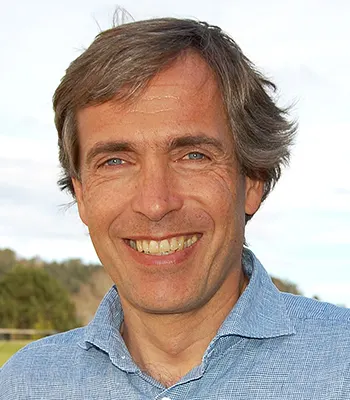
Prof. Geir Evensen (Invited Keynote Speaker)
Chief Scientist at NORCE (Norway)
Talk Title:
Controlling inflow boundary conditions in a lattice Boltzmann LES model for urban flows
In his invited lecture, Geir detailed how data assimilation can control and improve uncertain boundary conditions passed down when nesting localized microscale simulations inside coarser weather prediction models. Configuring the system as a standard parameter estimation problem, his team applied the Ensemble Smoother with Multiple Data Assimilation (ESMDA) over four update steps. Using local wind measurements within the simulation domain, they proved that a minimal sensor array can recursively correct time-varying boundary inflows, yielding stable, reliable urban flow structures over time.

Nikolaj Takata Mücke
Postdoc at TU Delft (Netherlands)
Talk Title:
Ensemble Smoothing for Joint State and Parameter Estimation in Turbulent Urban Flows
Running data assimilation across completely different fluid dynamics software engines is traditionally a software engineering nightmare. Nikolaj introduced pyurbanair, a unified Python abstraction layer developed for our project that wraps over three major Fortran-based solvers: uDALES, PALM, and a custom LBM (Lattice Boltzmann Method) code.
Nikolaj's talk outlined an approach for estimating dynamic inflow conditions and states from a small set of measurements using ESMDA. By conducting synthetic experiments, using one model as ground truth and the others for estimating parameters, he highlighted the inherent difficulties in data assimilation for turbulent flows. Furthermore, he demonstrated how Neural Surrogates can be used to speed up the process. Because running full Large-Eddy Simulations (LES) is computationally expensive, training a deep 3D ConvNeXt U-Net offline allows the neural network to step in as a drop-in forward model inside the ESMDA inner loop—yielding massive computational speedups with great tracking accuracy.

Prof. Dr. Femke C. Vossepoel
Professor Earth System Simulation at TU Delft (Netherlands), Scientific coordinator of UrbanAIR
Femke challenged the conventional standards used to measure data assimilation success. While many projects solely evaluate metrics like Root-Mean-Square Error (RMSE) against sparse observations or immediate forecasting skill, these standard measures do not always reflect how well a system captures the true underlying probability distribution of parameters. From a strict Bayesian perspective, she argued that performance should be assessed by how well the posterior distribution is reconstructed. She also discussed how information theory metrics like entropy give insights for experimental design. Her presentation underscored the importance of selecting proper performance criteria to ensure robust, validated urban digital twins.

Dr. Jana de Wiljes (Invited Keynote Speaker)
Professor in Mathematics of Data Science at Ilmenau University of Technology (Germany)
Talk Title: Sequential Learning Methods for High-Dimensional Data Assimilation
Focusing on the strict mathematical architecture of state tracking, Jana's invited lecture investigated continuous ensemble Kalman filtering under fixed, randomized, and adaptively varying partial observations. Her work establishes rigorous mathematical bounds for expected tracking errors in chaotic dynamical systems. She introduced an innovative sequential learning scheme that adaptively balances observation complexity with tracking accuracy, helping manage the "curse of dimensionality" when isolating the ideal filter-relevant state subspace.
All workshop presentations and materials are being progressively compiled on the official EnKF Workshop 2026 Portal.

As the workshop wrapped up last week, the UrbanAIR delegation returned from Rosendal with clear, collaborative objectives. Moving forward through our Horizon Europe timeline, the consortium will focus on:
Further refining localization strategies, ensemble sizing, and window lengths for high-dimensional states.
Strengthening the long-term rollout stability of our machine learning neural surrogate models.
Scaling these unified data assimilation tools up from idealized layouts to ultra-large, complex real urban geometries across our pilot cities of Antwerp, Barcelona, Paris, Bristol, and Rotterdam.
Many thanks to the organisers of the EnKF Workshop 2026 for putting together such an inspiring and engaging program and bringing the data assimilation community together in a spectacular Norwegian setting. We are looking forward to more knowledge-sharing beyond the workshop and future collaborations!
Stay tuned—more updates on our activities are coming up!


Comments